Here’s our guide on figuring out what kind of tank you’re looking at in an online listing. If you want to learn more about tanks, you can read our article about tanks.
Naming
In Europe tanks are named by the volume inside of them. In the US most tanks are named based on how much compressed gas in cubic feet they can hold at their maximum service pressure. Usually the number is close to the actual capacity, but if you are switching between tanks and want to calculate your gas consumption, it’s usually off by a few percent.
Is it Steel or Aluminum?
Aluminum tanks will have a flat bottom. They may or may not have a boot. Steel tanks in the US all have a spherical bottom and need a boot to stand upright. Tech divers are very anti-boot. Ultimately you just have to know what all the common tanks look like to be able to tell from a blurry picture.
Common Steel Tanks
2L (15 cf)
A small steel tank mostly used with rebreathers
3L (23 cf)
Longer version of 2L also mostly used with rebreathers. Usually you see these mounted vertically on a rebreather, but some rebreather divers use them in tandem as sidemount cylinders.
4L (27 cf)
Low pressure tank
LP50
Commonly used in sets of two by tech divers in back or sidemount. Some older tanks are rated for higher pressure and hold 72 cf. New tanks are panted dark grey. Older tanks were galvanized.
LP72
The most popular tank for many decades in cold water where the extra weight is desirable. Usually hot dipped galvanized and sometimes painted over.
LP95
8” diameter tank
LP108
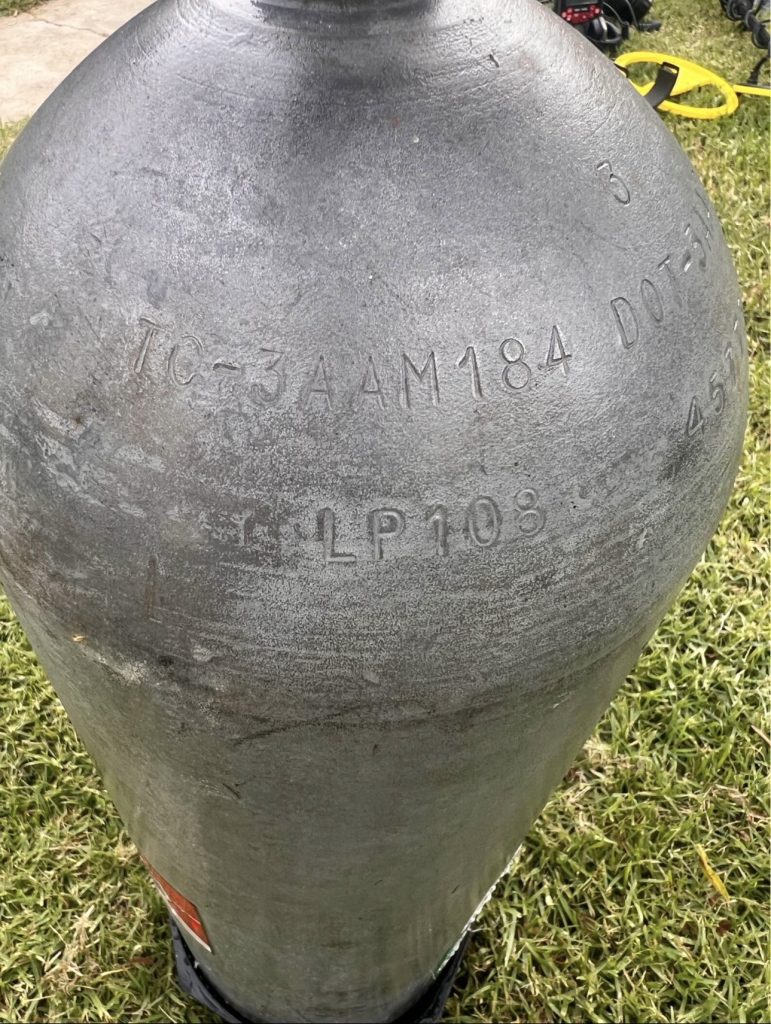
LP120
Common Aluminum Tanks
AL6
Commonly used to store inflation gas for a drysuit, filled with argon (lower thermal conductivity) and/or when using trimix which is very expensive.
AL13
A popular size for storing oxygen with some popular rebreather configs.
AL19
Popular small size of bailout bottle
AL20
Less common fat version of AL13. Used with the Zeagle Rapid Diver BCD System.
AL30
Common size of bailout bottle for safety divers. Sometimes used for decompression gas.
AL40
Most commonly used for decompression gas, like pure oxygen.
AL50
A tank sometimes used for small children
AL63
Most popular small tank for normal open circuit scuba
AL67
Uncommon tank that was once made
AL72
An uncommon tank that is currently in production
AL80
The most popular scuba tank
C80
Higher pressure scuba tank with extra aluminum making it more negatively buoyant
AL92
An uncommon tank
AL100
Most common large aluminum tank, higher pressure
C100
Like an AL100 but with more aluminum to make it heavier